Becoming Wise an Enquirey Into the Mystery and Art of Living
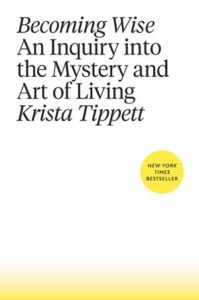 By Krista Tippett. Penguin Press, 2016. 288 pages. $28/hardcover; $17/paperback; $12.99/eBook.
Purchase from QuakerBooks
"I'm a person who listens for a living. . . . This book chronicles some of what I've learned." These are a few of the introductory words written by someone who to many Friends may non need introduction. The voices she listens to are her chat companions in her popular and honour-winning radio program On Beingness. She is the writer of the best-selling Speaking of Organized religion and Einstein's God.
The narrative of this book knits together excerpts from conversations she has had with a broad variety of partners—in an appendix she lists more than than 200. From Tippett'due south many conversations she has selected simply v "breeding grounds for wisdom" around which she structures her ofttimes personal narrative.
Words. Naming things and concepts brings their essence into being, and nosotros are set for fresh language to approach each other. The give-and-take "tolerance," for instance, no longer reaches far enough; it is as well small an idea for our present time. "The indicate of learning to speak together differently," she says, "is learning to alive together differently," not merely tolerating. This affiliate explores a variety of aspects of the art and skill of truly listening conversations, and Tippett provides splendid examples of how asking incisive and animative questions is a particularly powerful employ of words. In these and five more excerpted conversations that appear in the chapter's endnotes, she lucidly pieces together an astonishing multifariousness of insights.
The trunk. Heed and spirit join physicality into one inseparable whole. 1 of the conversations shines an illuminating calorie-free on the Jewish concept of the soul as not preexistent but emergent, formed only through physicality and relational feel: "We demand our bodies to claim our souls," she says. Some other of the conversational excerpts is an exploration of the worldwide L'Arche communities, illuminating the means in which the creation of support networks for those with mental disabilities illustrates this spirit–body wholeness, athletic and handicapped striving to share each other's lives. All the same another pointed out that Descartes's "I recall, therefore I am" is too cerebral, and should be "I feel, therefore I am"—we must non just remember our existence but feel it.
Dearest. The conversations excerpted here are searches for the strength and resilience behind a word that for Tippett is the most watered-down in the language. It'due south not just a feeling but a manner of being—searching in "the tranquillity spaces of the everyday in which we live and move and have our beingness." Information technology as well involves accepting the difficult task of appealing to the goodness in every human being and never giving upwards. The reality of this idea has been nowhere more forcefully and personally experienced than by the former civil rights activist Rep. John Lewis of Alabama. Another person interviewed claims that beloved is "similar dark matter, this force that permeates everything."
Organized religion. The subtitle of this chapter is "The Evolution." Truly living faith evolves from a childhood fear of not measuring up, through successive stages toward a mature faith: learning to reckon with the mysteries that brand life life. The origins of a deeper and sturdier mature organized religion are to be found in wondering, and this more or less sums upward the diverse ways interviewees saw their evolving faith. Tippett sees a remarkable growth of mature organized religion: centering prayer, spiritual direction, retreats, and meditation are becoming mainstream as never before. In that location is frequent exploration—nimbly sidestepping clichés—of the ways in which the mystic and the scientist are converging in their sense of wonder and never-catastrophe discovery.
Hope. It is not wish-based optimism, not an emotion, merely a firmly reality-based process. "It is a privilege," she says, "to hold something robust and resilient called hope." The L'Arche motion is invoked once again as a prominent case of this securely rooted conviction in goodness. This concluding affiliate is in many ways the most intense and personal of the book. Tippett never limits herself to simply quoting others, but in personal reflections reminds us of all that these conversations have stirred up in her. She reflects, "I am dazzled by the great good I can discern everywhere out at that place. I've shared a sliver in these pages, just a sliver."
Has this book shown united states of america routes to "becoming wise"? The two words of the title neatly wrap up the book's message: becoming—the path e'er rich with possibility—is wisdom, and the source of wisdom is this becoming. After journeying through all these broad-ranging conversations that she and so skillfully knits together, we meet that the reply has been at our fingertips all along: "We have it in united states to become wise." All of usa practice, and it is in opening new conversational spaces that nosotros unlock the wisdom in each other.
Source: https://www.friendsjournal.org/book/becoming-wise-inquiry-mystery-art-living/
0 Response to "Becoming Wise an Enquirey Into the Mystery and Art of Living"
Post a Comment